
Spam Alert!
While the percentage of spam emails has decreased slowly over the last decade, from ~57% to around 46%, there are still ~160 billion spam emails sent every day. So, if your inbox is less than half spam, you can thank your spam filters!
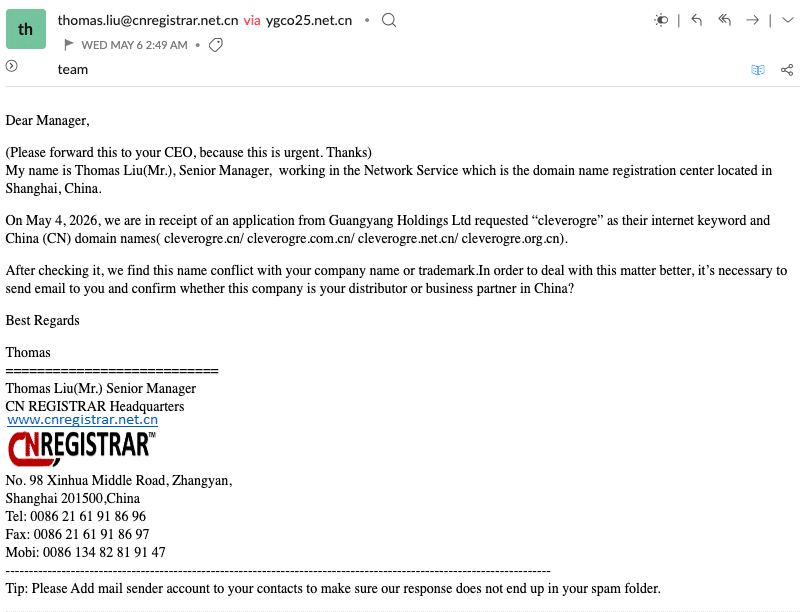
Here’s one that beat the odds and slipped its way past our security to our inboxes, and how we ID’d it as a potential scam:
Picture this: After years of hard work, you’ve successfully established a clean, effective, and on-brand presence across all of your media channels. You guard this work carefully, keeping on top of your metrics, responding to online reviews and social comments, and you never miss renewal dates for your domain hosting.
One morning, you open an email that makes your stomach sink: Some other company, in another country, is trying to register a domain with your brand name. This is apparently urgent — the purchase is about to go through unless you stop it now!
These domain name scams typically end up trying to sell you one or more versions of URLs that include your brand name. Instead of ending in .com, these domains often use their country’s top-level domain, such as .cn for China in the example above.
As you might have already guessed, there is probably no one trying to register your brand name in China. These scammers blast out emails to huge lists, then wait to see who responds. Once you reply, they kindly offer to register the names for you so you don’t have to deal with the language barrier. So helpful!
Generally, registering a domain costs around $7–$20 per domain, per year, but they’ll try to bill you for hundreds, sometimes even thousands of dollars for yearly registrations. Of course, if your company has plans for expanding into foreign markets someday, securing country-specific variations of your brand name might be a smart move — but grossly overpaying these scammers to do it definitely isn’t.
As always, watch out for “urgent” requests, and keep your skeptical spectacles sharply focused!
Remember, Scammers Count on You Clicking!
Don’t click links in emails! Instead, look up email addresses and phone numbers for customer service, be skeptical, and listen to your spidey senses.
Good Luck!